Resources / White papers
Engineering news, white papers and application insights.
Stay up to date with new products, white papers, and developments from Ole Wolff.

Resources / White papers
Stay up to date with new products, white papers, and developments from Ole Wolff.
White paper
November 2026

How do you get full-bodied bass out of a portable smart speaker with very little air inside?
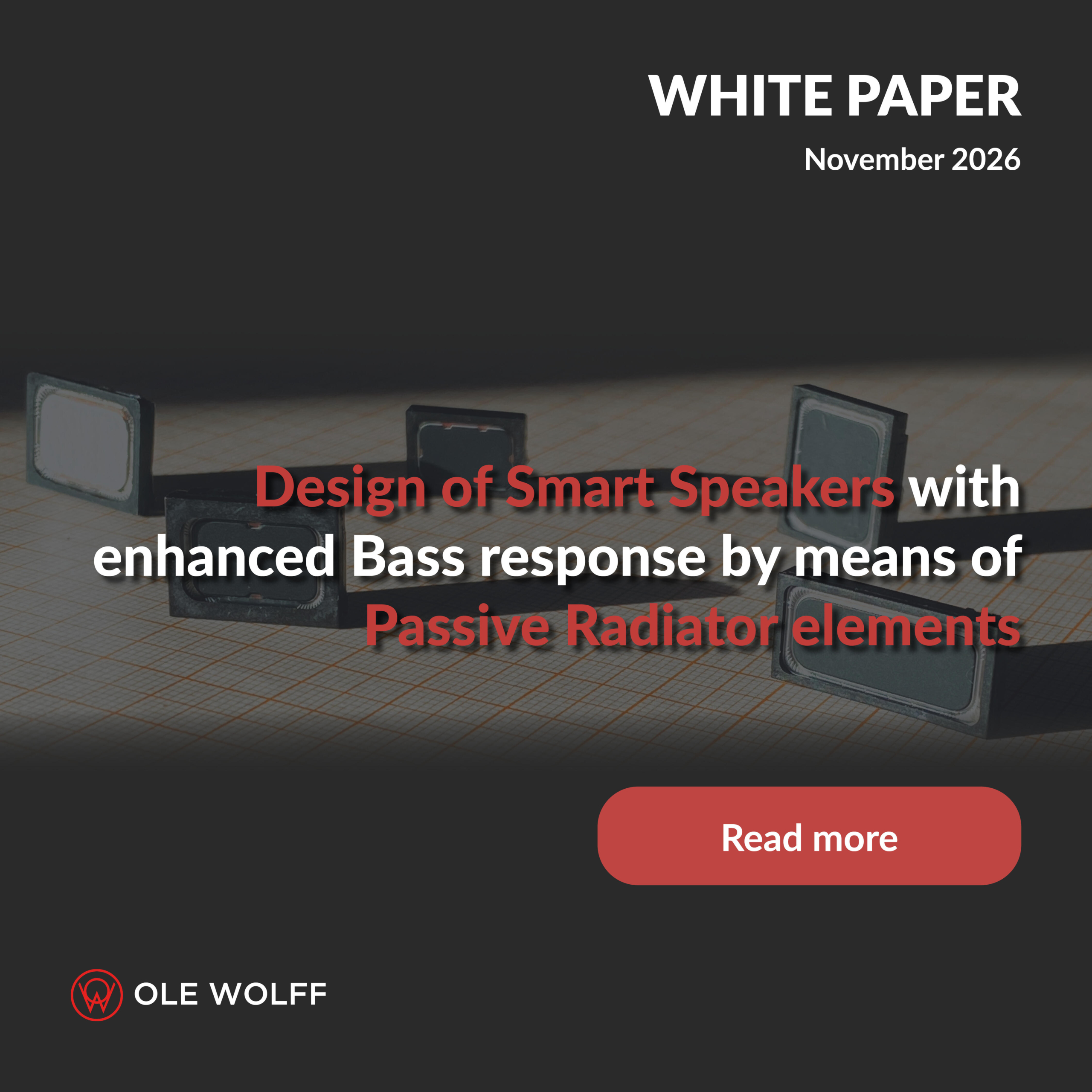
Our new white paper, shows how passive radiators do it, using a case study built around our 48mm OWS4848 driver.
Every smart speaker design runs into the same conflict: the device has to be as small as possible to stay portable, and it is still expected to deliver rich, full bass. Bass needs air, and a small enclosure has very little of it.
In our latest white paper, Design of Smart Speakers with Enhanced Bass Response by Means of Passive Radiator Elements, we look at one of the most effective ways around this: the passive radiator.
What’s inside?
A passive radiator is a speaker with no magnet system and no voice coil. It is a “slave diaphragm” driven by the sound pressure inside the cabinet. When it is tuned slightly below the driver’s resonance frequency, it adds intensity to the low end without needing a bigger box. The white paper explains how this works, and why it often beats a bass reflex port in compact designs.
It also covers the trade-offs designers need to plan for:
Case study: OWS4848 in a 150 ccm enclosure
The core of the paper is a simulated design using our OWS4848 driver in a 150 ccm closed box, which is typical of today’s smart speakers. With two passive radiators, the simulations show about 5–10 dB of extra output between 50 and 100 Hz, before any equalization is applied.
The paper includes the full driver and radiator parameters, the lumped-parameter model, and frequency- and phase-response curves. It ends with a practical takeaway on signal processing below the radiator’s resonance that’s easy to miss and can cost you performance if you do.
If you’re working on a portable or smart speaker design, this white paper gives you a clear starting point for a passive radiator solution. Download it below, and contact us if you’d like support with your next design project.
 https://owolff.com/wp-content/uploads/2026/11/news_compressed-scaled.jpg
2560
2560
Thomas
https://owolff.com/wp-content/uploads/2026/05/Logo_m_hvid_tekst_200x38px.png
Thomas2026-11-23 09:28:422026-11-23 10:06:13Design of Smart Speakers with enhanced Bass response by means of Passive Radiator elements
 https://owolff.com/wp-content/uploads/2026/09/news-1-scaled.jpg
2560
2560
Thomas
https://owolff.com/wp-content/uploads/2026/05/Logo_m_hvid_tekst_200x38px.png
Thomas2026-09-14 10:20:132026-10-29 10:12:46Advanced magnet system design technology for moving coil drivers and micro speakers for portable devices
 https://owolff.com/wp-content/uploads/2026/05/news-scaled.jpg
2560
2560
Thomas
https://owolff.com/wp-content/uploads/2026/05/Logo_m_hvid_tekst_200x38px.png
Thomas2026-05-12 11:33:462026-05-12 11:36:21The challenge of inappropriate HF response in Headphone drivers
ALL NEWS →